The Third Man (1949)
The Third Man seems to be regarded as film noir by default only, as if it's simply the most convenient way to discuss the film. Of course it's always been a loose genre descriptor, and The Third Man fulfills plenty of the requirements — murder, intrigue, a mysterious woman and sharp, if not particularly hard-boiled dialogue. But the famous score, performed on a zither, tends to work against the cynical nature of the film, lightening the dark corners and shadows particular to the genre, often lending a more lighthearted feel, full of smirk and humor. The darkest, and most interesting element is the setting. Pulp novelist Holly Martins (played by Joseph Cotton) is drawn to post-war Vienna to meet a friend, Harry Lime, who promises work in the crumbled city. Vienna's bombed-out buildings are never too far off screen, lending an added weariness to the otherwise fast-paced mystery.
After the long flight in from the states, Holly arrives at Harry's apartment only to learn that his friend was struck and killed by a car the day before. The death was deemed an accident, but as soon as Holly starts asking questions, he learns of Harry's black-market entanglements and circle of bizarre friends who were present the day of the incident. Holly is now the main character in a suspense story seemingly ripped from one of his own adventure novels, and he intends to write the ending.
Allied-occupied Vienna is interesting for a reason beyond the bullet holes — it was divided into four regions following WW2 — United States, Soviet Union, United Kingdom and France, with all four bureaucracies and police departments butting heads and created even more difficulties as Holly tries to protect Harry's former lover, and crack the case. Orson Welles doesn't appear until just passed the midway mark, and does so with a wink and smile. His charismatic supporting role carries the film past the somewhat predictable twist, through a beautifully-staged climax in a massive sewer system and towards the inevitable conclusion. British director Carol Reed employs lot of off-angle and skewered shots, and the film is often incorrectly and casually attributed to Orson Welles. It has been ranked as the best British film of the 20th century, and it won some Oscars and the Grand Prix at the Cannes in 1949. I liked it a bit less than the hype, but it's good none-the-less. A-
Showing posts with label wasted postage. Show all posts
Thursday, September 23, 2010
Tuesday, September 21, 2010
Wasted Postage: Reports from the Netflix Theater
The Lady From Shanghai (1947)
The Lady From Shanghai's more inconsistent elements become more understandable once you know a bit of history behind the film. An early-ish film noir, it was one of Orson Welles' several troubled projects following Citizen Kane. And, despite his pedigree, the studio yanked control of his original, two hour-plus cut and hacked it down to just short of 90 minutes. Despite shuffling any coherence or pacing it might have had, what was impossible to destroy was the daring camera work — extreme close ups, unnerving dutch angles and his always masterful framing of contrast and shadow.
Welles also wrote the film, and starred as a tough Irish veteran from the Franco wars in Spain. After a chance meeting with Rita Hayworth in a NY park, he's lured by the femme fatale
against his better judgment to serve as a deck hand on her husband's yacht. As the boat sails through one exotic locale after another, stopping for island excursions and picnics, Welles is sucked into the miserable life occupied by Hayworth's wealthy, defense-attorney husband and his law partner, who find joy in nothing but sitting around drinking and shoveling insults and pithy sarcasm on each other. Naturally, Welles appears to be the ideal escape for Hayworth, and the two begin to plot a future together as the two lawyers plot something different entirely.
Upon docking the yacht in San Francisco, the film's second half begins as a cynical court-room satire and spins into a disorientating jaunt through several elaborate set pieces, the most famous being a deserted fun house and its oft-copied hall of mirrors climax. The finale is done so well — it refuses to feel tired despite 60 years of copy cats — that the entire film feels better in hindsight. The acting is top-notch for the most part, save for Welles questionable Irish brogue. But the two best performances come from Everett Sloan's understated, devilish turn as the husband Arthur Banister, and Glenn Anders portrayal of his insane law-partner George Grisby. The two really give The Lady From Shanghai its joyous slime. B+
The Lady From Shanghai's more inconsistent elements become more understandable once you know a bit of history behind the film. An early-ish film noir, it was one of Orson Welles' several troubled projects following Citizen Kane. And, despite his pedigree, the studio yanked control of his original, two hour-plus cut and hacked it down to just short of 90 minutes. Despite shuffling any coherence or pacing it might have had, what was impossible to destroy was the daring camera work — extreme close ups, unnerving dutch angles and his always masterful framing of contrast and shadow.
Welles also wrote the film, and starred as a tough Irish veteran from the Franco wars in Spain. After a chance meeting with Rita Hayworth in a NY park, he's lured by the femme fatale
against his better judgment to serve as a deck hand on her husband's yacht. As the boat sails through one exotic locale after another, stopping for island excursions and picnics, Welles is sucked into the miserable life occupied by Hayworth's wealthy, defense-attorney husband and his law partner, who find joy in nothing but sitting around drinking and shoveling insults and pithy sarcasm on each other. Naturally, Welles appears to be the ideal escape for Hayworth, and the two begin to plot a future together as the two lawyers plot something different entirely.
Upon docking the yacht in San Francisco, the film's second half begins as a cynical court-room satire and spins into a disorientating jaunt through several elaborate set pieces, the most famous being a deserted fun house and its oft-copied hall of mirrors climax. The finale is done so well — it refuses to feel tired despite 60 years of copy cats — that the entire film feels better in hindsight. The acting is top-notch for the most part, save for Welles questionable Irish brogue. But the two best performances come from Everett Sloan's understated, devilish turn as the husband Arthur Banister, and Glenn Anders portrayal of his insane law-partner George Grisby. The two really give The Lady From Shanghai its joyous slime. B+
Tuesday, August 17, 2010
Wasted Postage: Reports from the Netflix Theater
The White Ribbon (2009)
In the early 20th century, parents sometimes tied a white ribbon on a boy's arm or in a girl's hair, to remind of them of purity, innocence and most of all, obedience. It was one of the less oppressive physical acts of parenting imposed by the families eking out an existence in pre-WWI Germany's lingering feudal system. Michael Haneke's latest film explores the roots of extremism — how it festers in over-worked, envious and hungry communities that grasp at any straw within reach. The Germany, 1913 setting has obvious implications for the religiously and emotionally oppressed children in the film, who will reach adulthood by the time of Auschwitz. But the central story has been, and will be, repeated throughout cultures world wide, and currently presents itself in the Arab world, as Haneke has said in interviews. Still, the German setting adds more gravity to the events captured in stark black-and-white, as we begin to see the unintended consequences of the childrens' upbringing, and the parental denial.
The White Ribbon opens with a doctor returning home on his horse, only to be be thrown from his ride and nearly killed by a wire strung between two trees. The attempted murder is the first in several heinous and unsolved crimes, including the torture of the land baron's young son, that slowly undue the small farm town's sense of prosperity and unity. A meek yet competent school teacher is the first to sense and admit to the growing sense of horror and its true roots, but as with all unspoken truths, it's too much for the supposed leaders of the community to admit. B+
Hot Tub Time Machine (2010)
With a name as irreverent as Hot Tub Time Machine, you'd think the film makers would ditch more than just titular conventions. Instead, the 99 minutes following the title card are about as conventional as the '80s sex comedies and time travel flicks it occasionally tries to lampoon, but more often than not limply follows. You've got the ski-bum bully in the Zabka mold (just not quite as blond), and a plot that hinges on moments from the protagonists' past that set them into a lifelong pattern of loserdom, with time travel as an opportunity to change the course of their lives. And, of course, one nerdy character who insists in a responsibility to avoid the dreaded "butterfly effect." Rob Corddry is the most reliably funny as HTTM's Stifler, known here as "The Violator." Overall it's pretty funny — several '80s sight gags work as well as always, but the running jokes that get better with each reiteration are canceled out by an equal amount that don't, and the whole thing is hindered by regularly desperate grasps for hipness. B-
In the early 20th century, parents sometimes tied a white ribbon on a boy's arm or in a girl's hair, to remind of them of purity, innocence and most of all, obedience. It was one of the less oppressive physical acts of parenting imposed by the families eking out an existence in pre-WWI Germany's lingering feudal system. Michael Haneke's latest film explores the roots of extremism — how it festers in over-worked, envious and hungry communities that grasp at any straw within reach. The Germany, 1913 setting has obvious implications for the religiously and emotionally oppressed children in the film, who will reach adulthood by the time of Auschwitz. But the central story has been, and will be, repeated throughout cultures world wide, and currently presents itself in the Arab world, as Haneke has said in interviews. Still, the German setting adds more gravity to the events captured in stark black-and-white, as we begin to see the unintended consequences of the childrens' upbringing, and the parental denial.
The White Ribbon opens with a doctor returning home on his horse, only to be be thrown from his ride and nearly killed by a wire strung between two trees. The attempted murder is the first in several heinous and unsolved crimes, including the torture of the land baron's young son, that slowly undue the small farm town's sense of prosperity and unity. A meek yet competent school teacher is the first to sense and admit to the growing sense of horror and its true roots, but as with all unspoken truths, it's too much for the supposed leaders of the community to admit. B+
Hot Tub Time Machine (2010)With a name as irreverent as Hot Tub Time Machine, you'd think the film makers would ditch more than just titular conventions. Instead, the 99 minutes following the title card are about as conventional as the '80s sex comedies and time travel flicks it occasionally tries to lampoon, but more often than not limply follows. You've got the ski-bum bully in the Zabka mold (just not quite as blond), and a plot that hinges on moments from the protagonists' past that set them into a lifelong pattern of loserdom, with time travel as an opportunity to change the course of their lives. And, of course, one nerdy character who insists in a responsibility to avoid the dreaded "butterfly effect." Rob Corddry is the most reliably funny as HTTM's Stifler, known here as "The Violator." Overall it's pretty funny — several '80s sight gags work as well as always, but the running jokes that get better with each reiteration are canceled out by an equal amount that don't, and the whole thing is hindered by regularly desperate grasps for hipness. B-
Monday, August 9, 2010
Wasted Postage: Reports from the Netflix Theater: books to film addition
The Road (2009)I still haven't finished Cormac McCarthy's source work for The Road, despite that it falls into one of my favorite genres — post-apocalyptic dystopian futures. But judging from the half I did read, John Hillcoat's film adaptation is about as faithful as they come. A nameless father and son wander a desolate landscape void of plant or animal life and dotted by dead treas. They push a shopping cart filled with their few remaining possessions — some crayons, paper, blankets, a few morsels of food, and a handgun with two bullets saved for the worst. They dodge cannibalistic drifters, stumble into a house of human livestock, and experience all other sorts of inhumane survival. It's nihilistic, grim stuff without an ounce of relief. Hillcoat was definitely the right man to bring McCarthy's hard-as-nails survival story to the big screen (everyone should check out Hillcoat's equally grim Australian western The Proposition). Despite reaching an unexpectedly emotional apex before concluding, when most of a film involves its main characters contemplating suicide, you're left wondering "What's the point?" B
The Girl with the Dragon Tattoo (2009) This one also begs the question, what's the point? Not because it's a bad movie, it's actually pretty good, but because I already read the book. What's the point of watching a thriller/mystery when you already know where and when all the thrills end? It kind of kills the suspense. And as fun as it is seeing the pages realized on film, I kind of like my brain's version more. Of course, all of this can be said for any film adaptation. There's almost no way to judge it on its own merits, but I will try. The Girl with the Dragon Tattoo is perfectly cast, especially Lisbeth Salander, the emotionally disturbed hacker punk/private investigator who helps journalist Mikael Blomkvist look into corporate corruption, an ugly family secret and a series of brutal serial murders. I would even say that in its effort to translate the 600-page novel in to 2.5 hours of film, the required plot streamlining even improves upon some of the book. But again, knowing all the twists, red herrings and surprises ahead of time, I was bored at a few junctures. I'm guessing someone who doesn't know how it ends would like this quite a bit, so it's gonna get a B+. (An American remake staring Daniel Craig and a bunch of other people better looking than the Euro actors here is currently in pre-production, with David Fincher ("Se7en," "Zodiac") directing.)
Monday, June 21, 2010
Wasted Postage: Reports from the Netflix Theater
Where the Wild Things Are (2009)
There are few things more annoying than listening to an 8-year-old make things up as he goes along for 90 minutes. Also, I don't care about the relationship problems of imaginary beasts in an imaginary forest (whether they are metaphorical or not). At least it all looked really pretty. C-
Up in the Air (2009)
A movie of our nation's time and place, even if it's most obviously exactly that, Up in the Air is good. Honest with its characters, it doesn't gift them easy redemption or eureka revelations, instead allowing them nuanced changes and growth. About 2/3 of the way through, the viewer might begin smelling some whiffs of formulaic rom-com contrivances, but directer Jason Reitman corrects the course for the final act. A-
Sherlock Holmes (2009)
I watched this on an airplane, alright? Shit was rank. About what I expected, even with director Guy Ritchie's energy. Why does every CGI fest set in 19th century (I think) Europe have identical and desaturated backdrops? Everything looks like a League of Extraordinary Gentleman video game — the blacks aren't really black, the whites are gray and not a red or yellow hue is to be seen. D
There are few things more annoying than listening to an 8-year-old make things up as he goes along for 90 minutes. Also, I don't care about the relationship problems of imaginary beasts in an imaginary forest (whether they are metaphorical or not). At least it all looked really pretty. C-
Up in the Air (2009)
A movie of our nation's time and place, even if it's most obviously exactly that, Up in the Air is good. Honest with its characters, it doesn't gift them easy redemption or eureka revelations, instead allowing them nuanced changes and growth. About 2/3 of the way through, the viewer might begin smelling some whiffs of formulaic rom-com contrivances, but directer Jason Reitman corrects the course for the final act. A-
Sherlock Holmes (2009)
I watched this on an airplane, alright? Shit was rank. About what I expected, even with director Guy Ritchie's energy. Why does every CGI fest set in 19th century (I think) Europe have identical and desaturated backdrops? Everything looks like a League of Extraordinary Gentleman video game — the blacks aren't really black, the whites are gray and not a red or yellow hue is to be seen. D
Wednesday, May 12, 2010
Wasted Postage: Reports from the Netflix Theater
An Education (2009)
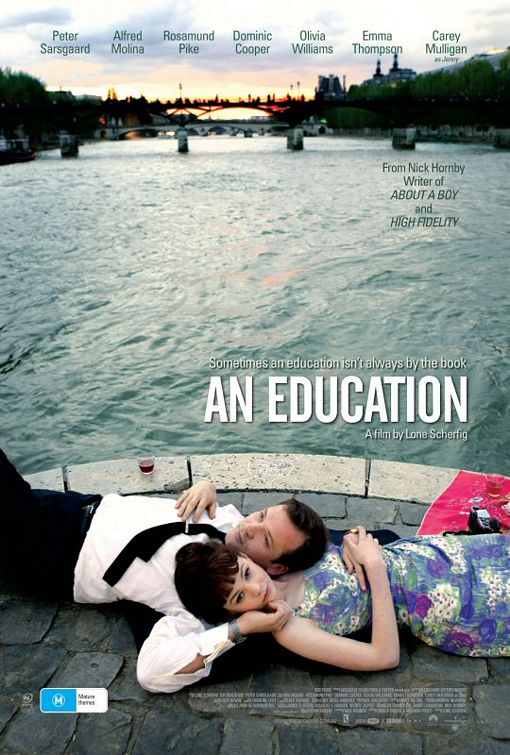
Breaking a movie's meaning down to a cliche can often be the best way to identify its theme, I learned durin' ma schoolin'. So here goes: "Struggle makes success sweeter," or "Success is a journey not a destination," (or whatever the correct version of one of those sentiments are). In An Education, Jenny [Carrie Mulligan, who deserves all the praise she received for her performance, and who may soon overtake Zooey Deschanel (aren't people tired of her yet?) as every music/art-inclined boy's fantasy] is a straight A-student in '60s London with dreams of Oxford. Her parents are square but loving, and they want the best for their little princess. All this changes when an older man, David (Peter Sarsgaard), strikes up a friendship with the sophisticated-beyond-her years, French-film and jazz loving teenager. Of course, his interest is less than platonic, as is hers. He woos her with trips to France, money and a lifestyle that would have taken her hard work and labor to achieve down the road. Of course she jumps at the chance to go to exciting upper-class restaurants and night spots, the race track and other place of wine, lobster and art. But, what about her own growth, and is all that really satisfying without the personal sense of accomplishment? The film's grace and elegance carries the more obvious plot points, at times (maybe this is just because it takes place in '60s Europe) reminding of French New Wave cinema's easy cool (without the creative editing). A final twist that still allows for a Hollywood ending may be too much for a film meant to educate its title character, but An Education still remains thoughtful. B+
Tuesday, April 20, 2010
Wasted Postage: Reports from the Netflix theater
The Informant! (2009) The Informant!, on the surface, feels like the kind of movie that should have been written/directed/produced by the Coen brothers — a hapless businessman way over his head, played by a paunchy, mustachioed Matt Damon (in the Coen universe it would have been William H. Macy), a '90s Midwest setting (Decatur and Springfield, Il) ripe for comedic picking. But while the Coens would have led down absurdest and surrealist paths of symbolism, director Steven Soderbergh lets the ridiculousness of it's real-life protagonist Mark Whitacre (Matt Damon) do all the work. Whitacre was a VP of ADM, the corn processing giant, who worked undercover for two years with the FBI to expose price-fixing and other supposed scandals. He proves a hilariously bumbling yet, despite himself, competent spy, fluent in several languages but with way more book smarts than street. Like an absent-minded Patrick Bateman in the Midwest (without the serial killing) Whitacre's brain drifts hilariously aloof from one materialistic aside to another — thoughts of buying new ties to whether he likes the feeling of wool on skin and other meaningless absurdities. Example: "I've been to Tokyo. They sell little-girl underwear in the vending machines right on the main drag, the Ginza, or whatever. Guys in suits buying used girl panties. How is that okay? That's not okay."
Among the wandering thoughts, he's prone to delusions of grander and totally oblivious to the fact that he will probably not be awarded the CEOship for attempting to bring down ADM's top brass. With manic depression's highs and lows, Whitacre lets the excitement and greed get in the way of his "moral" crusade, but proves ultimately endearing for his childlike naivety and indefatigable spirit. Also, this film slyly says more about the American justice system — it's perverse bureaucracy and fucked priorities — than anything else this year. David Simon would be proud. A
Fantastic Mr. Fox (2009) Is Fantastic Mr. Fox the tweeist little twee-fest in the history of twee? Yes. But it's also as painfully detailed, sardonic, witty and dry as anything in director Wes Anderson's filmography (Royal Tenenbaums, Life Aquatic, Rushmore, etc). But with all little things just right, the plotting provides the weak link. As Fox (George Clooney) and his band of ornery woodland creatures (Bill Murray, et al) do battle with mean ole Farmer Bean, the rules seem to constantly change (now Fox can dig is way out of any problem, now he can't, now he can again, etc). But, the familial themes familiar to any Anderson film provide the real backbone — jealousy, trust, betrayal and redemption. And, the animation looked stunning in Bluray, every little stop-motioned, hand-placed piece of fur or yarn is clearly defined and as painstakingly detailed as any live-motion set ever dreamed by the lanky auteur. B+
Angels and Demons (2009) Ugh, the papal mystery, European setting and pseudo history do provide an oddly intriguing premise, but Ron Howard is still a hack and Tom Hanks is still no Harrison Ford. At least the mullet is gone. A definite improvement on the god-awful Da Vinci Code ... but enough with the damn symbols. C-
Zombieland (2009) This movie rocked. No reason to say anything else, really. Fun time. A
The Men Who Stare At Goats (2009) — I really wanted to hate this. It's "wacky" New Ageism, boomer nostalgia, based-on-a-true-story excuse for existence. But what I found was a likable, light-hearted look at some of the more eccentric LSD casualties of the '60s. I'm tired and lazy and don't want to get into it, but just know that the movie is ridiculous and dumb but pretty funny and entertaining. B
Among the wandering thoughts, he's prone to delusions of grander and totally oblivious to the fact that he will probably not be awarded the CEOship for attempting to bring down ADM's top brass. With manic depression's highs and lows, Whitacre lets the excitement and greed get in the way of his "moral" crusade, but proves ultimately endearing for his childlike naivety and indefatigable spirit. Also, this film slyly says more about the American justice system — it's perverse bureaucracy and fucked priorities — than anything else this year. David Simon would be proud. A
Fantastic Mr. Fox (2009) Is Fantastic Mr. Fox the tweeist little twee-fest in the history of twee? Yes. But it's also as painfully detailed, sardonic, witty and dry as anything in director Wes Anderson's filmography (Royal Tenenbaums, Life Aquatic, Rushmore, etc). But with all little things just right, the plotting provides the weak link. As Fox (George Clooney) and his band of ornery woodland creatures (Bill Murray, et al) do battle with mean ole Farmer Bean, the rules seem to constantly change (now Fox can dig is way out of any problem, now he can't, now he can again, etc). But, the familial themes familiar to any Anderson film provide the real backbone — jealousy, trust, betrayal and redemption. And, the animation looked stunning in Bluray, every little stop-motioned, hand-placed piece of fur or yarn is clearly defined and as painstakingly detailed as any live-motion set ever dreamed by the lanky auteur. B+
Angels and Demons (2009) Ugh, the papal mystery, European setting and pseudo history do provide an oddly intriguing premise, but Ron Howard is still a hack and Tom Hanks is still no Harrison Ford. At least the mullet is gone. A definite improvement on the god-awful Da Vinci Code ... but enough with the damn symbols. C-
Zombieland (2009) This movie rocked. No reason to say anything else, really. Fun time. A
The Men Who Stare At Goats (2009) — I really wanted to hate this. It's "wacky" New Ageism, boomer nostalgia, based-on-a-true-story excuse for existence. But what I found was a likable, light-hearted look at some of the more eccentric LSD casualties of the '60s. I'm tired and lazy and don't want to get into it, but just know that the movie is ridiculous and dumb but pretty funny and entertaining. B
Tuesday, April 6, 2010
Wasted Postage: Reports from the Netflix theater
The Box (2009)
A film this reviled by audiences must be doing something right, right? Those were my first thoughts after seeing The Box's cinemascore rating (which compiles audience reaction as they exit a theater). I mean, a public so enamored with, well you know — the stuff they're enamored with — must universally hate this film because A.) it was likely unpredictable, B.) It was "boring," or perhaps C.) it made them uncomfortable. I arrogantly assumed it was the audience's insecurity, and not a lack of film craftsmanship that led to the low score. We're talking about a movie-going public that regularly makes the high-budget hackwork of Michael Bay the top grossing film of every summer. The day Transformers 2 came out, my Facebook newsfeed was overwhelmed with "OMG Transformers was awesomer" statuses.
The film's pedigree is intriguing at least: director Richard Kelly already has one cult classic under his belt, Donnie Darko, and one unwatchable, incoherent mess, Southland Tales. The Box was supposedly his attempt at Hollywood genre filmaking, the kind of picture adored by movie buffs for its adherence to genre thrills, and enjoyed by audiences for its straight-ahead suspense. It was even an adaptation of one of the Twilight Zone's most beloved writers, for Christ's sake.
As it turns out, I totally understand why audiences hated The Box. If Kelly set out to make a genre piece, he fails. The first half misfires on nearly all grounds: suspense, atmosphere, and most of all — pacing. The thing just lurches along. But then, right when you're ready to turn the fucker off, comes the philosophical/ethical premise: a middle class couple (Cameron Diaz and some dude) are presented a box with a red button. If they push the red button, they will immediately be given $1 million cash, but a person that they don't know will also be killed. After receiving the cash, the box will be delivered to another couple that they don't know, which implies exactly what you think it implies.
After they make their decision, weird stuff starts happening. Then even weirder stuff, and then Kelly loses his damn mind right when things actually start to get conspiratorial — the NSA, NASA, lightening, Mars launches, murder, cover ups, and then, wait for it, doors made out of water that transport people to different dimensions. Kelly couldn't even make a decent, tightly conceived thriller. The whole thing reeks of a nice short story that, once placed into the hands of a LSD burnout, turns into a 2,000 page manifesto about aliens, or something. D+
A film this reviled by audiences must be doing something right, right? Those were my first thoughts after seeing The Box's cinemascore rating (which compiles audience reaction as they exit a theater). I mean, a public so enamored with, well you know — the stuff they're enamored with — must universally hate this film because A.) it was likely unpredictable, B.) It was "boring," or perhaps C.) it made them uncomfortable. I arrogantly assumed it was the audience's insecurity, and not a lack of film craftsmanship that led to the low score. We're talking about a movie-going public that regularly makes the high-budget hackwork of Michael Bay the top grossing film of every summer. The day Transformers 2 came out, my Facebook newsfeed was overwhelmed with "OMG Transformers was awesomer" statuses.
The film's pedigree is intriguing at least: director Richard Kelly already has one cult classic under his belt, Donnie Darko, and one unwatchable, incoherent mess, Southland Tales. The Box was supposedly his attempt at Hollywood genre filmaking, the kind of picture adored by movie buffs for its adherence to genre thrills, and enjoyed by audiences for its straight-ahead suspense. It was even an adaptation of one of the Twilight Zone's most beloved writers, for Christ's sake.
As it turns out, I totally understand why audiences hated The Box. If Kelly set out to make a genre piece, he fails. The first half misfires on nearly all grounds: suspense, atmosphere, and most of all — pacing. The thing just lurches along. But then, right when you're ready to turn the fucker off, comes the philosophical/ethical premise: a middle class couple (Cameron Diaz and some dude) are presented a box with a red button. If they push the red button, they will immediately be given $1 million cash, but a person that they don't know will also be killed. After receiving the cash, the box will be delivered to another couple that they don't know, which implies exactly what you think it implies.
After they make their decision, weird stuff starts happening. Then even weirder stuff, and then Kelly loses his damn mind right when things actually start to get conspiratorial — the NSA, NASA, lightening, Mars launches, murder, cover ups, and then, wait for it, doors made out of water that transport people to different dimensions. Kelly couldn't even make a decent, tightly conceived thriller. The whole thing reeks of a nice short story that, once placed into the hands of a LSD burnout, turns into a 2,000 page manifesto about aliens, or something. D+
Monday, March 15, 2010
Wasted Postage: Reports from the Netflix Theater
A Serious Man (2009)
In the trailer for the Coen brothers' latest, the sound of family man Larry Gopnik's head, thumped against a chalkboard, soundtracked two-minutes of impending domestic and professional disaster, eventually reaching a nearly unbearable tension relieved only by Jefferson Airplane's "Somebody to Love." It was one of the most affective trailers I've ever seen, but stretch that feeling to 90+ minutes, and it feels more like the audience's head is the one being pummeled by the tragedy and travails of Gopnik's slowly disintegrating life. It's an effective pummeling, we watch as his family, career and Jewish religion methodically fall apart in 1960s small-town Iowa. We see one institution after another fail Larry, but after more than an hour of both subtle and not-so subtle misery, I ask, why in the world do I need to subject myself to picket-fence and chrome-fender hell? What am I learning here other than that some men are so ineffectual and nebbish that even when they're staring down the path of certain disaster they refuse to put a foot down? I suppose the very fact that the Coens pushed me to a point that required asking these questions of purpose and life and art means that the bastards, once again, did their fucking job, even if that means filming one of the most nihilistic endings I have ever seen (or was it?) B+
Crank 2: High Voltage (2009)
Co-directors Neveldine-Taylor's first Crank film was a gloriously over-the-top send-up (hopefully) of Mountain Dew-Xtreme-Doritos action movies. Crank 2 is more of the same, but the shtick has gone cold, and the depths they must plunge to continuously shock the audience often becomes just mean, ugly, increasingly bloody — and eventually just not fun anymore. C-
The Brothers Bloom (2008)
Director Rian Johnson doesn't completely fulfill the promise he showed with his endlessly inventive debut, the film-noir-via-modern-high school mashup Brick, but he shows increased range by replacing some of his edgier instincts with at-times nauseating whimsy and over-the-top production. As with Wes Anderson, Johnson constantly reminds his audience that this is a theater production, Ta-duh! His sets often look consciously like sets, the dialogue is, like in Brick, stylized and pointed, and the story is pure fantasy.
The Brothers Bloom follows two brothers who begin pulling cons before middle school. Older brother Stephen (Mark Ruffulo) writes the cons as elaborate stories where everyone gets what they want in the end, complete with the kind of symbolism found in "Russian novels," great betrayals, emotional climaxes and even a denouement. His brother, Bloom (Adrian Brody) is written into his cons as the charmer, the womanizer, the rogue. After decades playing games, Bloom is tired of living someone else's stories and vows, of course, to never pull another con again. Stephen drags Bloom back into the fold with one final con, the manipualtion of a beuatiful, rich shut-in (Rachel Weisz) who has never much left her parent's mansion, had any fun, nor shared her wealth with anyone else.
The Brothers Bloom mostly avoids the dreaded She's All That moment — when the con man tells the woman "at first it was a bet, but now I really love you" — by leading the audience down that obvious path before cutting through several twists and turns. The Brothers Bloom is a story about stories, dreams and living the life you want to live, though at points it would have been nice to get lost in a film that doesn't constantly remind its audience that a story arc is nothing more than a magnificent con of manipulated emotions. B
The Invention of Lying (2009)
The premise is the movie here, with plot often an afterthought and character development not an issue because everyone is basically the same — mean inner monologues become out-loud conversations, and every insecurity and judgmental thought is spoken. The Invention of Lying often confuses over-sharing with honesty. If you think someone is ugly, keeping it to yourself is not necessarily lying, it's simply not talking. Of course, the brutally "honest" conversations during a date between writer/director/star Ricky Gervais and Jennifer Garner — sample dialogue — "you are fat and have a snub nose, we will not be having sex tonight, and you probably won't get a kiss" provides a few laugh-out-loud lines but also a lot of cruelty. Often, the most enjoyable parts are the details. In a world without lies, advertising takes on a whole new strategy, movies are limited to narrators reading the most popular stories from the non-fiction canon, and there is no religion. But eventually even a premise-as-plot has to justify its run-time, and that's when the Invention of Lying strays into a half-assed, satirical parable of religion and it's function as the opiate of the masses. Gervias never makes a cogent argument for or against the ultimate lie of heaven and hell, instead landing occasionally clever jabs against the "man in the sky," and his followers. C+
In the trailer for the Coen brothers' latest, the sound of family man Larry Gopnik's head, thumped against a chalkboard, soundtracked two-minutes of impending domestic and professional disaster, eventually reaching a nearly unbearable tension relieved only by Jefferson Airplane's "Somebody to Love." It was one of the most affective trailers I've ever seen, but stretch that feeling to 90+ minutes, and it feels more like the audience's head is the one being pummeled by the tragedy and travails of Gopnik's slowly disintegrating life. It's an effective pummeling, we watch as his family, career and Jewish religion methodically fall apart in 1960s small-town Iowa. We see one institution after another fail Larry, but after more than an hour of both subtle and not-so subtle misery, I ask, why in the world do I need to subject myself to picket-fence and chrome-fender hell? What am I learning here other than that some men are so ineffectual and nebbish that even when they're staring down the path of certain disaster they refuse to put a foot down? I suppose the very fact that the Coens pushed me to a point that required asking these questions of purpose and life and art means that the bastards, once again, did their fucking job, even if that means filming one of the most nihilistic endings I have ever seen (or was it?) B+
Crank 2: High Voltage (2009)
Co-directors Neveldine-Taylor's first Crank film was a gloriously over-the-top send-up (hopefully) of Mountain Dew-Xtreme-Doritos action movies. Crank 2 is more of the same, but the shtick has gone cold, and the depths they must plunge to continuously shock the audience often becomes just mean, ugly, increasingly bloody — and eventually just not fun anymore. C-
The Brothers Bloom (2008)
Director Rian Johnson doesn't completely fulfill the promise he showed with his endlessly inventive debut, the film-noir-via-modern-high school mashup Brick, but he shows increased range by replacing some of his edgier instincts with at-times nauseating whimsy and over-the-top production. As with Wes Anderson, Johnson constantly reminds his audience that this is a theater production, Ta-duh! His sets often look consciously like sets, the dialogue is, like in Brick, stylized and pointed, and the story is pure fantasy.
The Brothers Bloom follows two brothers who begin pulling cons before middle school. Older brother Stephen (Mark Ruffulo) writes the cons as elaborate stories where everyone gets what they want in the end, complete with the kind of symbolism found in "Russian novels," great betrayals, emotional climaxes and even a denouement. His brother, Bloom (Adrian Brody) is written into his cons as the charmer, the womanizer, the rogue. After decades playing games, Bloom is tired of living someone else's stories and vows, of course, to never pull another con again. Stephen drags Bloom back into the fold with one final con, the manipualtion of a beuatiful, rich shut-in (Rachel Weisz) who has never much left her parent's mansion, had any fun, nor shared her wealth with anyone else.
The Brothers Bloom mostly avoids the dreaded She's All That moment — when the con man tells the woman "at first it was a bet, but now I really love you" — by leading the audience down that obvious path before cutting through several twists and turns. The Brothers Bloom is a story about stories, dreams and living the life you want to live, though at points it would have been nice to get lost in a film that doesn't constantly remind its audience that a story arc is nothing more than a magnificent con of manipulated emotions. B
The Invention of Lying (2009)
The premise is the movie here, with plot often an afterthought and character development not an issue because everyone is basically the same — mean inner monologues become out-loud conversations, and every insecurity and judgmental thought is spoken. The Invention of Lying often confuses over-sharing with honesty. If you think someone is ugly, keeping it to yourself is not necessarily lying, it's simply not talking. Of course, the brutally "honest" conversations during a date between writer/director/star Ricky Gervais and Jennifer Garner — sample dialogue — "you are fat and have a snub nose, we will not be having sex tonight, and you probably won't get a kiss" provides a few laugh-out-loud lines but also a lot of cruelty. Often, the most enjoyable parts are the details. In a world without lies, advertising takes on a whole new strategy, movies are limited to narrators reading the most popular stories from the non-fiction canon, and there is no religion. But eventually even a premise-as-plot has to justify its run-time, and that's when the Invention of Lying strays into a half-assed, satirical parable of religion and it's function as the opiate of the masses. Gervias never makes a cogent argument for or against the ultimate lie of heaven and hell, instead landing occasionally clever jabs against the "man in the sky," and his followers. C+
Monday, March 1, 2010
Wasted Postage: Reports from the Netflix theater
Moon (2009)
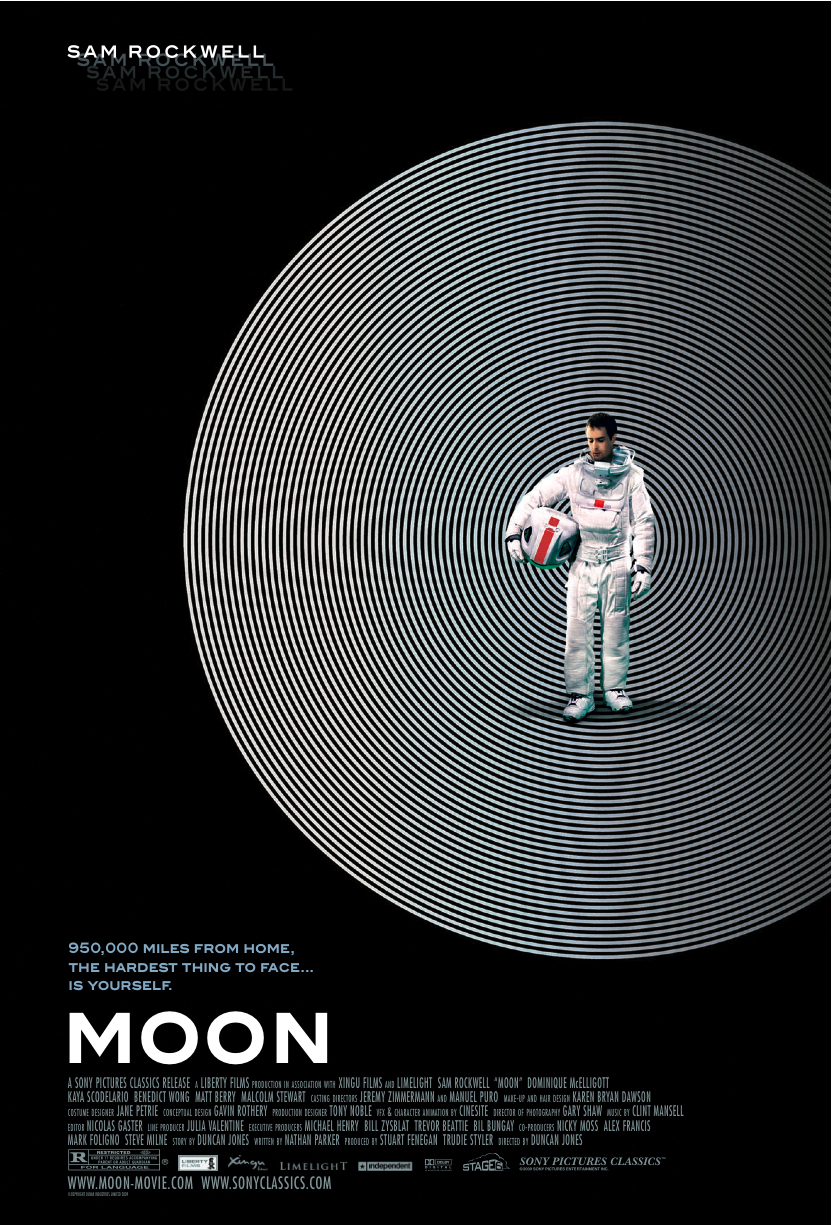
Would you enjoy hanging out with yourself? I probably wouldn't. (I'm offering a spoiler alert here, though this review wont spoil the ending, or reveal anything not available in the trailer. But the film's twist about 25 minutes in is also its premise, and makes it nearly impossible to write about without being revealing. You're better off seeing Moon without seeing the trailer, or knowing too much about it. I'll the save you the trouble of reading an entire review here: it gets an A-. Go see it.)
Moon starts out with Sam Bell (Sam Rockwell), eking out the final two weeks of a three-year contract alone on a corporate moon space station. So Sam is on the moon, all alone, starting to lose it a bit, his only companion a H.A.L.-like assistance robot named GERTY (voiced by Kevin Spacey). Sam starts seeing things, burns his hand, gets clumsy, and after he awakes in the medical bay after crashing a harvester, Sam's corporate parents suddenly lock the doors. Sam doesn't remember the accident. So he tricks GERTY into letting him out of the base, where he finds his own body still sitting in the harvester. Turns out that one, or both, of the Sams is a clone ... or then again maybe Sam's totally lost it. The remaining hour finds the two fighting, eventually coming to terms with their predicament, and then trying to find a way to the truth of their origins and maybe away off the moon before the "rescue team" arrives. Moon is infinitely clever, and as with the best indies, a low budget forces film makers to cut fat and make a movie worth seeing. A-
The Hurt Locker (2009)
The Hurt Locker removes politics, and ... makes the first decent Iraq war film. But The Hurt Locker is more than decent, it is masterful suspense film making, rendering the soldiers as soldiers and not political mouthpieces. It makes the Iraq War into Everywar, with soldiers dedicated to their country, each other, but still honestly miserable — war is hell, whether its an urban environment or a beachhead. Not every soldier is miserable, though. Jeremy Renner plays SSG William James, an adrenaline-junkie bomb defuser who's dismantled hundred of IEDs without losing a finger. It's the one thing he loves, and when you see him in a supermarket between deployments, it's a terrifying out-of-place surreal moment akin to seeing Ray Liotta in Goodfellas picking up the newspaper in suburbia thanks to the witness protection program. A
Gamer (2009)
The Running Man-meets-Avatar premise held promise to provide the genre thrills every sci-fi nerd craves. Dystopian future? Check. Evil technology/Luddite pandering? Check. Inmates killing for redemption? Check. 'splosions? Check. Repugnant, insulting-on-several-levels, pilfering unoriginality, feeds-off-the-same-ills-it-criticizes mess? Check. Gamer is a repulsive film.
Gerard Butler stars in the Schwarzenegger role, a military man (presumably) falsely imprisoned for 1st degree murder. He must make it through 30 rounds of a real life first-person-shooter video game named "Slayer," where he is controlled by a gamer sitting at home. Through some pseudo-science jabber (always my favorite part), we are told how villain Ken Castle (Michael C. Hall from Dexter) created a kind of microbiological computer processor that's implanted into the inmates brain's cells, allowing players at home to control their every action in the "game." Inmates use real bullets. Heads explode, bodies are ripped apart. Through interviews and media clips, we learn how Castle became both famous and beloved and the richest man on the planet after he invented "Society," a Sims-like video game using the same technology as "Slayer," in which gamers at home inhabit the bodies of actors in various settings. "Society" allows its players (shown as morbidly obese sweat-sacks dipping finger-food in syrup) to act out their most heinous and carnal fantasies —blood, sex and ugly behavior being the main attraction. Gamer uses "Society" as its excuse to parade ugliness on the screen, criticizing our internet age with one side of it's mouth while titillating the audience with the other. These are the kind of titties you do not enjoy.
Back to the action, co-directors Neveldine and Taylor take the chopped-and-screwed approach to editing — fast-motion cuts to slow-mo — before the screen distorts and flashes static to remind audiences that it's watching a video game. The effect is epileptic at best. The shaky camera and bazillion cuts per second make it impossible to enjoy the giant action set pieces. Not that the action follows any sort of logic. JUST GIVE ME A GODDAMN ENJOYABLE POPCORN FLICK. Why is this so hard? Also, Ludacris plays the film's desperate attempt at a cyber-punk, leading the future's hacker elite resistance to Castle and his dehumanizing virtual-reality empire. And, of course, the evil secret from Castle's past that could end the whole nightmare resides in Butler's skull. Luda wants it, and his best hacker has dreadlocks, etc. F
Would you enjoy hanging out with yourself? I probably wouldn't. (I'm offering a spoiler alert here, though this review wont spoil the ending, or reveal anything not available in the trailer. But the film's twist about 25 minutes in is also its premise, and makes it nearly impossible to write about without being revealing. You're better off seeing Moon without seeing the trailer, or knowing too much about it. I'll the save you the trouble of reading an entire review here: it gets an A-. Go see it.)
Moon starts out with Sam Bell (Sam Rockwell), eking out the final two weeks of a three-year contract alone on a corporate moon space station. So Sam is on the moon, all alone, starting to lose it a bit, his only companion a H.A.L.-like assistance robot named GERTY (voiced by Kevin Spacey). Sam starts seeing things, burns his hand, gets clumsy, and after he awakes in the medical bay after crashing a harvester, Sam's corporate parents suddenly lock the doors. Sam doesn't remember the accident. So he tricks GERTY into letting him out of the base, where he finds his own body still sitting in the harvester. Turns out that one, or both, of the Sams is a clone ... or then again maybe Sam's totally lost it. The remaining hour finds the two fighting, eventually coming to terms with their predicament, and then trying to find a way to the truth of their origins and maybe away off the moon before the "rescue team" arrives. Moon is infinitely clever, and as with the best indies, a low budget forces film makers to cut fat and make a movie worth seeing. A-
The Hurt Locker (2009)
The Hurt Locker removes politics, and ... makes the first decent Iraq war film. But The Hurt Locker is more than decent, it is masterful suspense film making, rendering the soldiers as soldiers and not political mouthpieces. It makes the Iraq War into Everywar, with soldiers dedicated to their country, each other, but still honestly miserable — war is hell, whether its an urban environment or a beachhead. Not every soldier is miserable, though. Jeremy Renner plays SSG William James, an adrenaline-junkie bomb defuser who's dismantled hundred of IEDs without losing a finger. It's the one thing he loves, and when you see him in a supermarket between deployments, it's a terrifying out-of-place surreal moment akin to seeing Ray Liotta in Goodfellas picking up the newspaper in suburbia thanks to the witness protection program. A
Gamer (2009)
The Running Man-meets-Avatar premise held promise to provide the genre thrills every sci-fi nerd craves. Dystopian future? Check. Evil technology/Luddite pandering? Check. Inmates killing for redemption? Check. 'splosions? Check. Repugnant, insulting-on-several-levels, pilfering unoriginality, feeds-off-the-same-ills-it-criticizes mess? Check. Gamer is a repulsive film.
Gerard Butler stars in the Schwarzenegger role, a military man (presumably) falsely imprisoned for 1st degree murder. He must make it through 30 rounds of a real life first-person-shooter video game named "Slayer," where he is controlled by a gamer sitting at home. Through some pseudo-science jabber (always my favorite part), we are told how villain Ken Castle (Michael C. Hall from Dexter) created a kind of microbiological computer processor that's implanted into the inmates brain's cells, allowing players at home to control their every action in the "game." Inmates use real bullets. Heads explode, bodies are ripped apart. Through interviews and media clips, we learn how Castle became both famous and beloved and the richest man on the planet after he invented "Society," a Sims-like video game using the same technology as "Slayer," in which gamers at home inhabit the bodies of actors in various settings. "Society" allows its players (shown as morbidly obese sweat-sacks dipping finger-food in syrup) to act out their most heinous and carnal fantasies —blood, sex and ugly behavior being the main attraction. Gamer uses "Society" as its excuse to parade ugliness on the screen, criticizing our internet age with one side of it's mouth while titillating the audience with the other. These are the kind of titties you do not enjoy.
Back to the action, co-directors Neveldine and Taylor take the chopped-and-screwed approach to editing — fast-motion cuts to slow-mo — before the screen distorts and flashes static to remind audiences that it's watching a video game. The effect is epileptic at best. The shaky camera and bazillion cuts per second make it impossible to enjoy the giant action set pieces. Not that the action follows any sort of logic. JUST GIVE ME A GODDAMN ENJOYABLE POPCORN FLICK. Why is this so hard? Also, Ludacris plays the film's desperate attempt at a cyber-punk, leading the future's hacker elite resistance to Castle and his dehumanizing virtual-reality empire. And, of course, the evil secret from Castle's past that could end the whole nightmare resides in Butler's skull. Luda wants it, and his best hacker has dreadlocks, etc. F
Friday, January 29, 2010
Wasted Postage: Reports from the Netflix Theater
Stranger than Paradise (1984)Jim Jarmusch's breakout, second film is an exercise in constraint and black-and-white minimalism. The camera barely moves inside the spare and grimy New York City apartments of the films first act, the frozen Cleveland streets of the second, or the cheap Florida motel of the third. Sudden moments of poignancy are littered among the quite spots between conversations and circular chatting. Stranger than Paradise follows Willie, a 20-something Hungarian immigrant who does his best to be all-American — watching baseball, eating TV dinners, speaking without an accent — until his teenage cousin Eva comes to visit from the old world. Willie is not exactly the consummate host to his fish-out-of-water (Jarmusch's favorite archetype) cousin, but by the time he finally sees the fun in teaching her his interpretations of America, she's on a train to Cleveland.
A year later, Willie and his friend Eddie, bored with their recent race-track winnings, head to Cleveland to visit Eva, innocently believing it will be a beautiful city on a lake. What they find is snow-blanketed and rusty. "You know, it's funny... you come to someplace new, and everything looks just the same," Eddie remarks. Soon, Willie, Eddie and Eva ditch the cold for Florida, searching for a place to call paradise.
Jarmusch's camera has a way of finding the rough corners and shaggy dogs in each on-location set, and nearly any still from the film would make a fantastic album cover or framed print. Stripped of action, with little plotting and sparse dialogue, Stranger than Paradise boroughs in and stays. The moments that stick — the little things matter — leave a strange, unnerving resonance waiting to be revisited. A
Big Fan (2009)
Patton Oswalt turns in a memorable dramatic performance as a man self-detrimentally obsessed with professional football. Working a dead-end tollbooth job, Oswalt passes the hours listening to sports talk radio, jotting down notes for his best moment of every day: his turn to call in and talk smack against Philadelphia Phil.
But when a chance encounter with his favorite NY Giants player ends with Oswalt in the hospital with brain hemorrhaging and a black eye, he is faced with either pressing charges against the man who nearly ended his life, or allowing the best player on his favorite team back on the field.
Big Fan is the directorial debut by former Onion editor and writer of The Wrestler Robert Siegel. It's namely a drama, but the first half showcases the kind of "funny because it's so true, and so depressing" observations often seen in Onion briefs. The rising action may leave some feeling manipulated, but the climactic point is worth the hardship and excessively depressing moments. B+
Funny People (2009)
Funny People works because it lets Adam Sandler essentially play himself, if he were a morbidly-depressed, sad-sack horseshit excuse for a human being. The role allows him to make fun of the inherent silliness of his "shibby-be-do-wa" shtick, the excess of entertainment's top rungs, and the self-deprecation that forms the basis for some of the best stand-up comedy, while at the same time allowing our generation to feel empathy for a character we grew up with in Billy Madison, etc. Integrating actual archival footage and pictures of Sandler, we are introduced to him as George Simmons, the aforementioned comedy superstar, told by his doctors in the first scene that he is dying of leukemia. This diagnosis prompts Simmons/Sandler to reevaluate his priorities and, you know, "find whats truly important." Enter Seth Rogen, a struggling up-and-coming stand-up still stuck in the doldrums of open-mic night at a popular improv club. He lives with Jonah Hill, a slightly more advanced but still struggling comic, and a hilariously clueless and vain network TV star played by Jason Schwartzman. After a chance meeting with Sandler, Rogen is offered the chance to write jokes for the dying comedian and serve as his all-around assistant/bitch, before, uh, they actually become real friends and stuff.
The best aspect of Funny People, besides the barrage of one-liners, the artful mastery of the dick joke and perfect ensemble cast, is the nuanced way they treat Sandler's "I'm-a-piece-of-shit-with-no-friends" epiphany — he doesn't use his illness so much to become a better person, he uses it as a tool of manipulation in a desperate attempt to win the heart of "the one that got away" (Leslie Mann). It may all be a bit fatalistic, but years of habit and personality don't change over the course of 2.5 hours, they just budge a little bit.
Also, they got James Taylor to say "fuck Facebook." B+
Tuesday, January 19, 2010
Wasted Postage: Reports from the Netflix theater
Hey look! Three spineless movie reviews, they all got Bs!
Extract (2009)
When Office Space writer/directer Mike Judge announced his return to the workplace comedy with Extract, it was something akin to Michael Jordan's return to basketball for the Initech cult. Alas, Extract more resembles Jordan's return to the Wizards, not his return to the Bulls after baseball — the quick first step and fade-away jumper are mostly still there — but of course it just doesn't feel the same. No two movies are the same, and if that were possible, it would just be redundant. So, it was wise for Judge's workplace follow-up to take place in a totally different world than Office Space — Extract's nameless southwest setting has more in common with Judge's long-running cartoon King of the Hill than it does the white-collar hell of Bill Lumbergh-land.
Jason Bateman stars as the owner of a small factory producing flavor extracts for cooking. His days typically deal with settling disputes between the lunkhead line workers and trying to find a buyer for his company before coming home each day to a sexless marriage. Things take a turn for the strange when con-woman Mila Kunis reads about a former Extract employee who recently lost his balls in a workplace accident, and sets about convincing said employee to sue for all the money he can. Ben Affleck turns in one of several great supporting performance as Bateman's bartender friend/drug-pusher who further complicates things when he convinces Bateman to fix his marital woes in the least honest way possible. Extract is very funny, I found myself laughing throughout much of its lean 90 minutes, and Judge still knows exactly how annoying people can be, nailing the ticks and quirks than can make your neighbors and co-workers unbearable. Perhaps it was a bit unfair to expect one man to define hourly-wage malaise for a second decade in row. B
Up (2009)
Pixar has never made a terrible film, but not every feature from the CG animation powerhouse is going to be a classic, no matter how hard critics try to convince us. Like every good Pixar production, Up gifts the adults in the theater with serious themes and emotions (Up deals with grief, memory, loneliness, friendship, goals, etc, especially well in a masterful, extended vignette showing the old man growing up) without stripping the film of colorful characters, humor and plot. I don't know how to say this in any interesting way, but Up just got kind of boring, I found myself begging the characters to just get the damn thing over with. I toyed with the idea of writing a review that sarcastically complained about how unrealistic Up is ("Hey, balloons can't pull a house!"), but there is actually some validity to believability and consistency issues, i.e. all that can be asked of any film is that it follows its own rules, the rules of whatever universe is established for the story. In Up, one minute the old man is totally reliant on a walker, the next he's fighting the villain while stopping an entire house from floating away by holding onto a garden hose. I can only suspend my disbelief for so long, even in a cartoon with a floating house and talking dogs. I'm a god-damned adult, right? B
In the Loop (2009)
This profane British political satire involves US and UK bureaucrats, generals, politicians and their young aids telling each other to fuck off, eat shit and die for 106 minutes, which is fine, because apparently the British have found ways to curse I didn't even know existed. I mean, these motherfuckers really know how to fucking curse. They make Goodfellas look like a goddamn episode of Mister Rogers' Neighborhood. As Americans, we should be ashamed. Filmed in the one-camera style of The Office, In the Loop often feels more like a long television episode than a feature film. At times, it brilliantly skewers the way war policy can often be a comedy of errors, incompetence and falsehoods. Other times it amounts to little more than hearing political rivals telling each other to fuck off, eat shit and die. B
Extract (2009)When Office Space writer/directer Mike Judge announced his return to the workplace comedy with Extract, it was something akin to Michael Jordan's return to basketball for the Initech cult. Alas, Extract more resembles Jordan's return to the Wizards, not his return to the Bulls after baseball — the quick first step and fade-away jumper are mostly still there — but of course it just doesn't feel the same. No two movies are the same, and if that were possible, it would just be redundant. So, it was wise for Judge's workplace follow-up to take place in a totally different world than Office Space — Extract's nameless southwest setting has more in common with Judge's long-running cartoon King of the Hill than it does the white-collar hell of Bill Lumbergh-land.
Jason Bateman stars as the owner of a small factory producing flavor extracts for cooking. His days typically deal with settling disputes between the lunkhead line workers and trying to find a buyer for his company before coming home each day to a sexless marriage. Things take a turn for the strange when con-woman Mila Kunis reads about a former Extract employee who recently lost his balls in a workplace accident, and sets about convincing said employee to sue for all the money he can. Ben Affleck turns in one of several great supporting performance as Bateman's bartender friend/drug-pusher who further complicates things when he convinces Bateman to fix his marital woes in the least honest way possible. Extract is very funny, I found myself laughing throughout much of its lean 90 minutes, and Judge still knows exactly how annoying people can be, nailing the ticks and quirks than can make your neighbors and co-workers unbearable. Perhaps it was a bit unfair to expect one man to define hourly-wage malaise for a second decade in row. B
Up (2009)
Pixar has never made a terrible film, but not every feature from the CG animation powerhouse is going to be a classic, no matter how hard critics try to convince us. Like every good Pixar production, Up gifts the adults in the theater with serious themes and emotions (Up deals with grief, memory, loneliness, friendship, goals, etc, especially well in a masterful, extended vignette showing the old man growing up) without stripping the film of colorful characters, humor and plot. I don't know how to say this in any interesting way, but Up just got kind of boring, I found myself begging the characters to just get the damn thing over with. I toyed with the idea of writing a review that sarcastically complained about how unrealistic Up is ("Hey, balloons can't pull a house!"), but there is actually some validity to believability and consistency issues, i.e. all that can be asked of any film is that it follows its own rules, the rules of whatever universe is established for the story. In Up, one minute the old man is totally reliant on a walker, the next he's fighting the villain while stopping an entire house from floating away by holding onto a garden hose. I can only suspend my disbelief for so long, even in a cartoon with a floating house and talking dogs. I'm a god-damned adult, right? B
In the Loop (2009)This profane British political satire involves US and UK bureaucrats, generals, politicians and their young aids telling each other to fuck off, eat shit and die for 106 minutes, which is fine, because apparently the British have found ways to curse I didn't even know existed. I mean, these motherfuckers really know how to fucking curse. They make Goodfellas look like a goddamn episode of Mister Rogers' Neighborhood. As Americans, we should be ashamed. Filmed in the one-camera style of The Office, In the Loop often feels more like a long television episode than a feature film. At times, it brilliantly skewers the way war policy can often be a comedy of errors, incompetence and falsehoods. Other times it amounts to little more than hearing political rivals telling each other to fuck off, eat shit and die. B
Labels:
Extract,
In the Loop,
Mike Judge,
Office Space,
Pixar,
Up,
wasted postage
Monday, December 28, 2009
Wasted Postage: Reports from the Netflix Theater
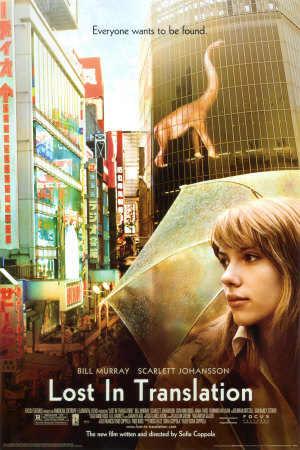
Lost in Translation (2003)This mid-decade hit examined the type of moment or experience that happens in real life — one that, once it's over, hasn't changed anything dramatically, but leaves you feeling different, or perhaps older. Whether this makes for exciting cinema is up to the viewer. Critics said "yes," emphatically, my parents said "no." I say "sort of." Director Sofia Coppola lets atmosphere and (actors, of course) do all the talking. Her camera stays out of the way, mostly moving slowly and occasionally lingering on an interesting image or reflection, which is probably a wise choice as the alien city of Tokyo is the third lead in the film, after Bill Murray and Scarlet Johanson. Murray plays a depressed actor filming a whiskey commercial in Japan. He doesn't know the language or anyone in Tokyo, and he spends his nights drinking and smoking in the four-star hotel's lounge. His stagnation is eventually interrupted by another bored westerner, Scarlet Johanson, a recent Ivy-league grad stranded in the same hotel while her photographer husband is off on a magazine photo-shoot. The two form a platonic relationship initially based on a shared sense of empty isolation, but the two manage to go out and have fun despite their solemn neurosis, and of course, learn a thing or two from each other. At times, Johanson's seeming unwillingness to just explore the goddamn city on her own can be infuriating. You're young. You're beautiful, you are in a crazy fucking landscape. Go do something. Eventually she does, it just takes a man delving headfirst in a midlife crises to get her there. Lost in Translation is not all doom and gloom. Murray's genius for physical comedy and wry interaction with the locals provides relief through the film's first half. The culture clash is interesting in it's own right, and the film has just enough character development and subtle detail to substitute for plot. B
The Goods: Live Hard, Sell hard (2009)
The Goods only gets away with its overly-familiar "slobs vs snobs" plot-arc because of its farcical self-awareness and admittance of only one aspiration — crossing the line as often as possible. It even has the arbitrary challenge the slobs must meet in order to save their dying (golf club, workout gym, fraternity, etc) car lot from the mean rich guys next door. It essentially just lets the starved plot lay there, like a foster kid adopted as a scheme for tax breaks, except here the tax breaks are fart and dick jokes, told by some of the better comedic actors available. As Jeremy Piven, the mercenary car salesman brought into save the dealership, says "Don't over think it."
Ed Helms has a ball playing an asshole in a "$40 hair cut" who manages the BMW dealership across town who is also in a has-been boy ban that once opened for O-Town.
There are some laugh-out-loud jokes, plenty of gags that arrive DOA — but also enough don't-give-a-fuck attitude to at least warrant a rental for anyone looking for a funny dumb time. (Cue joke about the movie getting "pushed off the lot," not buying a "lemon," etc). C+
The Stepfather (1987)
This B-movie horror classic was stripped of all its subtext and intrigue for a Hollywood remake this year, but the original still packs a bloody punch. Terry O'Quinn (Lost's John Locke) plays Jerry Blake, a Reagan-era man with punishable-by-death expectations for his family unit. The film begins with Blake shaving off his latest disguise — a full-on '80s beard — grabbing his briefcase, walking down the stairs past his dismembered family, and off to work, whistling as he walks.
The next scene finds him settling in with his new family several months later, a widow smitten by Blake's earnest charm and strong family values, and her trouble-making daughter who knows right away that there's something wrong with Blake. For the rest of the film, we see him creep closer to the edge of revisiting mass murder, and bump off a few townspeople along the way as he prepares to find a new family that might not be so damn disappointing. B+
Darkman (1990)This off-beat superhero flick flopped on the heals of Batman, but has since received a slowly growing cult of admiration. It was director Sam Raimi's (Spiderman, Drag Me to Hell) first foray into big-budget Hollywood after his Evil Dead success in the '80s. Raimi's slapstick-horror sensibilities often work well in the superhero universe (a universe with origins in brightly-colored comic books), and often cause a sense of unease when paired with the bloody emotions central to the film. His original story follows a scientist (Liam Neeson) who uses a prototype technology to reconstruct his face after a horrific fire. The only catch is the artificial skin disintegrates in light after 90 minutes. Neeson slowly uses several different faces to exact revenge on the crime syndicate that caused his disfigurement. It is a film ahead of it's time: an R-rated superhero dusted in melancholy and (true to it's name) darkness. Darkman is highly entertaining, occasionally cheesy in that special Raimi way, but always original. B- (also watch for a great surprise cameo from Bruce Campbell at the end)
Labels:
darkman,
lost in translation,
The Goods,
The Stepfather,
wasted postage
Monday, December 14, 2009
Wasted Postage: Reports from the Netflix Theater

Audition (2001)
The plot begins like a run-of-the-mill melodrama or romcom: a middle-aged widower (named Aoyama) is encouraged by his teenage son to find a new wife and start enjoying life. So Aoyama uses his TV producer connections to hold a sham audition for a nonexistent show to audition candidates for a new wife.
Ayoyama takes home the stack of resumes and head shots, and is instantly taken aback by a haunting essay about death and shattered dreams, written by one young aspiring actress. Even during the quiet moments between Aoyama and his friends/family, director Takashi Miike's masterful use of dutch angles, long shots, and the occasional use of a security-camera-esque angle stirs a sense of doom and unease.
Anyone familiar with Miike's work would be more shocked by how normal the film seems up to this point, and anyone who doesn't know anything about Audition should stop reading here if they like surprises.
As the AVClub calls it, Audition is a "gear-shift" movie, one that takes a radical new direction in tone and meaning halfway through the film. This shift is triggered about the time Aoyama calls the young actress at home, and the two begin a relationship. By this point, Miike has dipped in enough foreboding imagery and outright creepiness to let the audience know this isn't going to be a simple romance comedy/drama, but he hasn't even begun twisting his audience through dream sequences and real-life horror that overtakes the final act.
Miike's infamous filmography is not for the squeamish or easily offended. By the end of its run, Audition terrifies, shocks and repulses without losing the heart that anchored its first half. A-
Bruno (2009)
Sacha Baron Cohen hasn't lost his ability to shock, there's still plenty of way-past-the-line moments in Bruno that make his work feel edgy in a world dominated by uncensored internet videos and MA-rated prime-time. But where Borat held a mirror to the barely disguised racism (and every other -ism) that lurks just below the American surface, Bruno just, uh, makes a bunch of gay jokes. Luckily for Cohen, the jokes are still funny as hell, even if his main devises for landing those jokes are beginning to feel tired or even predictable. Being as famous as he is, tricking even the most isolated yokels into unforgiving interviews and set-ups must be becoming rather difficult for Cohen, and it seems that more and more of his segments are fully acted and fictional skits, and doesn't include as many moments where Cohen brilliantly punks an unsuspecting mark. The plot involves Bruno, Cohen's Austrian gay fashion designer, going to America with hopes to become famous. It all ends without much of a conflict or resolution, and as a coherent film it's not much to talk about. As a series of outlandish set-ups and individual gags, you will still laugh at the unbelievable length's Cohen is willing to go to, and the unbelievably soulless people he dupes along the way.B-
Whatever Works (2009)
During the pre-release run-up to "Whatever Works," promotional articles and reviews usually centered on the fact that the film was written by Allen 30 years ago and then shelved, only brought back to life when he found the perfect lead in Larry David.
The cynic in me wants to say this "old script" angle was pushed by Allen's studio to avoid reminding viewers that, if written today, the entire film could be viewed as Allen's justification for marrying his adopted daughter Soon-Yi Previn. Stick with me here. The title, "Whatever Works," refers to the love and relationship philosophy of Allen's surrogate in the film, Larry David — love and relationships are fleeting and one should ignore any and all social conventions in order to experience the ephemeral joy of "love." David's character is Boris Yellnikoff, a supposed physics genius who was "considered" for a Nobel Prize but never even nominated. He is exhaustively misanthropic and condescending, calling even the people he likes "earthworms" and "cretins." At first this proves entertaining as Yellnikoff shows no patience for even the poor tykes he teaches chess to for a living. Eventually the act becomes tedious, but is saved by several 4th-wall breaking monologues that rail against anything and everything that happen to pass through the irascible curmudgeon's skull.
Yellnikoff's life of hiding from the "earthworms" in his dingy loft come to a screeching halt when a young Dixie runaway named Melodie, played by Evan Rachel Wood, suddenly appears in his home begging for a place to stay. His pessimistic worldview and rapid fire insults masquerading as wisdom eventually rub off on the impressionable Melodie, though when she repeats them they are transformed from ugly to charming and innocent, and before long the two form an unlikely romantic relationship. Allen spares us from having to see wrinkly old Larry David and hotter-than-hell Evan Rachel Wood get "intimate," but this doesn't stop Allen from parading Wood around in her underwear or other skimpy outfits (thank god, haha). The main problem with "Whatever Works," becomes, eventually, Wood's lack of acting talent. Her fake southern accent is bad, her rhythms and body language are strained and, other than her good looks, she doesn't really contribute anything to the film.
The plot takes some unexpected turns as more God-fearing southerners appear in Manhattan and slowly evolve into the "Whatever Works" bohemians Allen so clearly embraces. In other words, if you support Sarah Palin, you will absolutely despise this film. The question becomes, "does Allen feel as superior to the southern yokels as his Yellnikoff character does? Is it all fiction, or does he believe that environment really does change people more than upbringing and roots? How easily do religious values disappear once people are exposed to new things?" Though flawed, even a minor Woody Allen film such as "Whatever Works" leaves the viewer with more to chew on than most anything else released in a given year. B-
Happiness (1998)No one should ever watch Happiness, for any reason, ever. Don't get me wrong, it's brilliantly acted and directed, and the script can hold its own, but the unrepentant doom, gloom and sadness is enough to scare anyone away from film for months. Director Todd Solondz trades away much of the black humor that levitated his most well known films, Palindromes and Welcome to the Dollhouse, for bleak catastrophe and depression. The characters here include a failed artist, a successful but soulless artist, a pederast, a murderous rape victim, a sex addict, a clueless yet arrogant housewife, a divorced couple in the their 70s, among others, all of whose lives are covered in shit in the beginning of the film and only sink deeper through the 2 hours 14 minutes run time. There are moments that could almost be considered comedy, but only in the darkest, most twisted and painfuly ironic variety. When the Solondz sick version of humanity fires on all cylinders, Happiness goes places no other film would dare, but when it pushes too hard, the ugliness can become nearly ridiculous. There are some conversations in the film, specifically an especially creepy "birds-and-the-bees" talk between a pubescent boy and his dangerous father, that are borderline preposterous. Then again, that saddest truth is that one is bound to find more "you-couldn't-make-this-stuff-up" ugliness in the cops/courts section of any local newspaper than in even the most preposterous moments in Happiness. B
Wednesday, December 2, 2009
Wasted Postage - Reports from the Netflix Theater

Revolutionary Road (2008)
In the last episode of "Curb Your Enthusiasm," Jason Alexander is ribbed by Seinfeld for promoting a book entitled "Acting without Acting," Alexander's attempt at a how-to guide for inspiring thespians. The book's goal is obvious: acting is accomplished through techniques and effort that are, when executed correctly, seamless and invisible to the audience. That trick, I imagine, only becomes more difficult when actors such as the stars in Revolutionary Road, Kate Winslet and Leonardo DiCaprio, are the types that pick prestige films to showcase their chops. It's nearly an invitation for an audience to take themselves out of the picture and think about how these two megastars are, in fact, acting like a disturbed married couple in '50s suburbia — trapped by the shell of conformity, expectations and what's "realistic." Leo inhabits his character fairly convincingly. For a while you forget he's a millionaire actor living in L.A., and think he really is an unhappy salesman who tries to validate his masculinity by sleeping with naive secretaries. Winslet is less successful but on occasion terrifying, though her performance may have been more hampered by Sam Mendez's direction, who, in an effort to depict Winslet's acceptance of desperation, unrealistically forces her to quickly resume smiling-housewife mode immediately following soul shattering arguments. It's all fire, and then all ice.
Throughout several one-on-one, back-and-forth exchanged, Winslet and DiCaprio have a sort of actors duel — who can out-scream, out-emote, out-intensify the other. Sometimes it works, sometimes it doesn't. But when it does, it knocks you on your ass. Every American can relate to the Richard Yates source material. The feeling that we do things only because we're expected to, and that we don't have the guts to break free of convention. Or even worse, that we are not special, and that we don't deserve to lead any sort of extraordinary life. DiCaprio and Winslet decide near the beginning of the film that they are, indeed, special. She convinces Leo to move to Paris, but before long, life gets in the way, and the couple unravels as they try to ignore their hopes and dreams and settle for predictability and mediocrity, with devastating conclusions.
Despite DiCaprio and Winslet's top billing, the real powerhouse performance is contributed by Michael Shannon's depiction of a mentally ill friend who initially finds the couple's desire to break free charming, before letting loose with a devastatingly honest analysis at a dinner party when he sees the once-promising couple dissolve into domestic hell. B+
Human Nature (2001) I saw this too many weeks ago to provide commentary respectful to the film's genius, so I'll provide a little background. Human Nature is sort of the bastard film of the best screenwriter of his generation, Charlie Kaufman, and charmingly whimsical director Michel Gondry. It was Kaufman's first film since the beloved Being John Malcovich (dircted by Spike Jonze), and the film just before Kaufman and Gondry's triumphant Eternal Sunshine of the Spotless Mind. So here sits Human Nature in the middle. Critics and audiences alike didn't know what to make of this absurdest comedy featuring a scientist who's obsessed with table manners (Tim Robbins), a woman with a bizarre genetic condition that causes her to grow hair everywhere (everywhere) who just wants to live like an animal in peace with nature, and a man raised in the wild to believe he's a monkey who Tim Robbins takes to civilize as an experiment. I'll leave it at that, only to add that there is a bizarre love triangle, awesome comedic performances, a midget, and the thought provoking mind-fucks only Kaufman can provide. AThe Rocker (2008)
Rainn Wilson's drum-solo facial expressions and gut-protruding leotards are enough to warrant "The Rocker" a watch. You know what would have helped? A band that actually rocked, and not the Ryan Cabrera-light schlock preformed throughout the 102 minute run time. C+
Star Trek (2009)
Easily the best big-budget action bonanza since The Dark Knight, Star Trek managed to entertain this non-trekkie for the full two-hour run time. It manages to avoid the inane plotting, offensively stupid dialogue and cliche motivations that drags Transformers and most every other summer event film into the doldrums of aneurysm-causing idiocy, proving that a film full of explosions, chases and fight scenes doesn't have to inspire suicide. Thank you for not treating me like a child.
If Star Trek has a flaw, it is one inherent in any prequel, reboot or origin story: no matter how nefarious a villain is, they're still not able to instill any sense of doubt or worry that things might not go well for Spock or Captain Kirk, lead characters created to reboot a franchise and star in future installments. That being said, Nemo (Eric Bana) doesn't really come close besting that impossible task, though he does have face tats that would make any Tool Academy student jealous. B+
Miami Blues (1990)Miami Blues was largely forgotten upon release — lukewarm reviews from critics, ignored by audiences — that has somehow gained a bit of the cult following, a status cemented (not really) by it write up in the AVClub's "Cult Canon" series. It's a noir that doesn't dwell in the shadows, instead displaying the blood and deceit squarely in the Florida sun. Like Body Heat, the '80s neo-noir remake of Double Indemnity, the hot, muggy setting is a character in itself. Staying in the noir tradition, it stars a suitable anti-hero as the protagonist, a man you wouldn't want to meet on the street but don't mind watching on screen. Alec Baldwin plays "Jr." an ex-con who first appears on screen catching a flight away from jail and towards Miami where he plans to break enough fingers and wring enough necks to carve out his own perverted version of the American dream. The guy even entertains white-picket fence fantasies with his new found hooker girlfriend (Jennifer Jason Leigh)
Baldwin's crime spree through Miami feels like the do-whatever-you-want sandbox gameplay of the "Grand Theft Auto" video game series, in that he generally does whatever the fuck he wants. Using a police badge stolen from a toothless (literally, not figuratively) detective on his tail (played by the always craggy Fred Ward) Baldwin steals, loots, handcuffs and generally makes a bitch out of Vice City. Miami Blues' strength lies in those traits criticized when it was released — that the plot mechanics relied on happenstance and brash decision making by characters instead of logical actions and consequence, and that events transpired with no particular rhyme or reason. Instead, Baldwin's manic performance and the seaming lack of real world concern give the film an unpredictable fever-dream like energy, bustling from one darkly-humorous catastrophe to another, rarely stopping to view the damage until it's too late. B
Thursday, October 29, 2009
Wasted Postage: Reports from the Netflix theater
The Night of the Hunter (1955)When John, the grade-school-age protagonist, is enveloped by the shadow of Robert Mitchum's black hat in the first act, you know you're in for one of the grimmest film noirs of the era — a special feat for a genre named after the French word for "dark." The children first see Mitchum standing ominously outside the front gate of their southern home like an owl waiting for its prey's first mistake. Initially, John and his sister don't know that Mitchum is at their home for a very sinister reason, a realization that comes to John much faster than adults easily taken in by Mitchum's dark charm. Mitchum's character, a sociopath with delusions of divinity, dresses like a preacher and has the the duality of man tattooed on his fingers. His perverted sense of love and hate is delivered with the power and articulation of an earnest sermon, though it has more in common with the hollow televangelists of today, interested in taking, not giving.
In "Night of the Hunter," he has come to take the fortune hidden by John's father shortly after a murderous bank robbery. John's father was arrested shortly after, and while on death row was cellmates with Mitchum, in jail briefly for auto theft. Only little John knows where the money is hidden. Before long it's a tension filled game of cat and mouse, with Mitchum slowly terrifying the children whenever the mother is in the other room. Despite a slightly disappointing second half and ending, the nearly flawless and unnerving first half has enough sparse and desolate scenes to fill plenty of quiet nightmares. AThe Big Steal (1949)
Robert Mitchum again stars here, a fast-moving and action-orientated noir set in Mexico. Standard plotting here, some money is stolen and everyone wants their hands on in. Mitchum is framed for a payroll he didn't steal and has to chase the guy who has it, while US military personnel pursues him below the border. A classic car chase is framed by Mitchum and co-star Jane Greer's stylized dialogue and solid chemistry. B+
Shrooms (2007)
"Hey, You guys wanna eat some ... SHROOMS?!?"
"OK, sure, let's go eat them SHROOMS (!!!) in the woods outside a haunted orphanage where children were tortured and killed!"
"We're just a bunch of cool and hot American kidz fornicatin' and takin' SHROOMS!!! in Europe, what could go wrong?"
"But watch out, don't eat the SHROOMS!!! with the black dot on top!"
"I really wish I hadn't eaten those SHROOOOOOOOOMS!!!"
The End.
I was just gonna leave this review like that, but two points: the whole thing is sort of a horror "Reefer Madness" for the shroom set, and the "twist" ending rips off ::SPOILER:: "High Tension." D
Monday, October 19, 2009
Wasted Postage: Reports from the Netflix Theater

Timecrimes (2007)
Time-travel sci-fi, when self-serious, can get bogged down in hypothetical discussions of tangent realities and space-time continuum gobbledygook that neither the writers nor the audience really understands. That's why Back to the Future is great, it's supposed to be a big ball o' fun and nothing more. It throws in a few space-time continuum nonsense explanations but nearly winks at the camera as it does it, acknowledging through Doc's manic performance that it's all just for fun. Timecrimes has a darker sense of humor, mostly that you can't trust just any old Hector with time travel, 'cause he will probably just muck everything up. Filmed in Spain, the film's spiraling series of events begins when a middle-aged milquetoast named Hector sees, with binoculars, a young woman undress in the woods behind his house. Once his wife leaves to run errands, he ventures out to investigate. When he gets close, a masked man stabs him and Hector is forced to flee to a nearby science lab where he stumbles upon a time machine. That sounds convoluted as hell, but Timecrimes actually aims small and makes good on the opening scares. It follows Hector throughout the course of the day, beginning with the bizarre violence that begin to make sense as we see back in time. Just when the circular plotting begins to become familiar and Hector tries to fix everything he screwed up with his first accidental time travel, it takes unexpected twists, while staying true to it's opening conceit. A
The Reader (2008) - The Reader not only features today's fashionable Oscar-bait casting choices (Ralph Fiennes and Kate Winslet), it even employs the Academy's favorite story structure: an old person looking back at several key moments in their life. Fiennes plays the wistful old lover here, looking back at his (here's where I should use the word 'torrid' or 'passionate') affair as a teenager with an older woman. That woman happened to be Winslet, playing a mid-thirties German strumpet who was a concentration camp guard during the Holocaust, unbeknown to Fiennes. Though her ruthlessly efficient and thoroughly German love-making (stereotype jokes are fun) and cold demeanor should have been a dead giveaway. This is the central twist that Fiennes doesn't realize until his mid twenties, during law school, when his class goes to visit Winslet's criminal trial.
In order to keep audiences engaged in a "torrid" love affair that is neither torrid nor especially passionate, the film's marketers advertised the twist as the film's premise, essentially letting film goers know to stay with it until the second half, when things supposedly get interesting. The one moment of inspiration comes from the outspoken douche in Fiennes' law school seminar, who becomes rightfully angry at the trial process that he said places the totality of blame for the Holocaust on a few guards, when there were millions of Germans who knew exactly what was going on. I'd say the odds are about 1-to-1 that he later joined the Baader-Mienhoff gang. The Reader fails to pose any interesting moral dilemmas or dig deep into the banality of evil, though it tries to do so in only the most austere and self-serious manner possible. It practically screams, tastefully of course, with the pinkie clearly extended and tea-in-hand. In other notes, Kate Winslet's character should probably have a sit-down with Chris Hanson. C+

Drag Me to Hell (2009)Following in the tradition of uh, his own films before he started making Spiderman crapfests, Drag Me to Hell is a Raimi-esque Sam Raimi splash into a cauldron of bloody camp and slapstick horror. The gore is hilarious, the gags are disgusting and the plotting is pitch perfect, but as with all of his horror-comedy films, I always want just a bit something more, even though I don't know what it is. In this case, the something more might just be less Justin Long, who seems to find his way into everything. The plotting follows the super-fine Alison Lohman, who plays a loan officer looking for a promotion at a small bank branch. When she denies an extension for some old Gypsy's mortgage, she gets cursed and has to spend the next 90 minutes getting abused by spirits in some humiliating ways, while convincing everyone she's not crazy and trying to get that damn promotion. This should have been a big hit, but instead the morons in suits cut it to a PG-13 rating and failed to get anyone in theaters besides fans of Raimi's other Raimi-esque work. B+/A-
Observe and Report (2009)
Writer/Director Jodi Hill may be as delusional as his deranged lead characters to think he could make a comedic Taxi Driver for the Apatow set. Predictably, Observe and Report never captures any of the weight of Taxi Driver, nor the laughs of Hill's Danny McBride vehicle Eastbound and Down. It jumps too quickly from slapstick gags and farcical sketches to maintain any dramatic momentum, despite several shorthand cinematic references to Scorsese's masterpiece. It can be pretty fucking funny though, even if it makes you feel a little guilty for laughing. Occasionally, it's as mean as The Foot Fist Way and East Bound and Down, and it continues Hill's characters' refreshing lack of sentiment or redeeming character traits. Though its barely-beating heart is seldom revealed outside of Rogen's scenes with his alcoholic mother. He plays mall security guard Ronnie Barnhardt — the McBride role — well, delusions of grandeur with a self-destructive streak. But he leaves McBride's possibly essential redneck coloring at home. Anna Farris plays the mindless party girl to perfection, she's a shallow slut with more love for "shots!" than her own well-being or self-esteem. Which brings us to the notorious date-rape scene, which is unflinchingly treated as a gag with no more care or seriousness than anything else. I don't know what to think of it. It's just presented matter-of-fact and then left alone. It happened. There are parts of "Observe and Report" that take place outside of anything remotely resembling reality, so much so that one wonders if Ronnie Barnhardt's fantasies of being an actual bad-ass actually become what's shown on screen. B-
Vicky Cristina Barcelona (2008)
Woodie Allen's first foray into Spain follows two American friends (ScarJo and some brunet) with opposite taste in relationships. ScarJo likes things passionate and occasionally self-destructive and her more uptight brunet friend has a reputable fiance and carefully planned future. Both end up falling for Javier Bardem's passionate artist, Juan Antonio, who indulges in Europe's more libertine attitudes. Eventually the other hottest woman in the world (Penelope Cruz) comes along as Bardem's ex-wife and things get weird.
VCB lets the audience ogle at some of the best looking people in Hollywood, placed near both old-Europe's beautiful city architecture and idyllic cottages and countryside. As with any Allen film, it allows us to question the idiosyncrasies of the human heart without feeling hokey or cheesy about it. And it's witty, of course. B+

Saturn 3 (1980)When I read the title, I figured, well, I haven't seen the first two Saturn flicks — not that I've ever heard of them — but I can probably catch myself up to speed. It turns out Saturn 3 is not a sequel to a film named Saturn, it's the name of the deep-space base where all the "action" takes place in this stand-alone '80s sci-fi abomination. More curious than Saturn 3's illconceived and misleading name is its A-list cast, comprised of Hollywood stars either well-before or well-after their prime. You've got a young Harvey Keitel, after his supporting role in Taxi Driver but before any other film roles I remember. All his dialogue is comically dubbed, and his strangely wooden performance was an attempt at the future, I guess. It's got Farrah Fawcett after her pin-up heyday, but she's still amazingly hot and she gets naked, briefly. Weirdest of all, though, is a geriatric Kirk Douglas as ... Fawcett's lover?
Douglas and Faucet play a couple who live on an isolated Saturn space base, visited by Keitel's vaguely creepy space pilot who arrives with some robot. Keitel's robot is named Hector, and it kinda looks like that episode of Futurama when Fry thinks he's a robot and starts walking around like one. In other words, Hector is a guy in a robot suit, built so it looks like it has no head. This is accomplished by building the costume's chest where the actor's head would be, and squaring off the shoulders up above the head. Anyway, Keitel's mind controls the robot, and when he gets the hots for Farrah .... the robot does, too. Eventually Hector goes all HAL and there is a dead dog and some awesome non-CGI gore. Hector is one horny robot and he goes berserk. Oh, and I almost forgot, the crappy special effects attempting to show the surface of the planet, space travel and anything else is funny enough to merit a watch in it's own right. There is one extraordinarily shitty attempt to portray flight in an asteroid field, which was plainly accomplished by filling a tub with water, dropped a bunch of Styrofoam rocks in it and then filming a miniature space ship flying by the "asteroids." It didn't look like anything close to outer space.
Saturn 3 was clearly trying to cash in on the Star Wars hysteria, even borrowing Episode IV: A New Hope's opening iconic shot of the spaceship's underbelly as it flies over the camera. It is a truly abysmal, terrible-beyond-belief attempt at sci-fi that can't even accomplish it's fairly modest goals. In other words, a must see. F+ (otherwise known as a gentleman's D-, or a bastard's F)
Valkyrie (2008)
Tom Cruise is a Nazi (oh but he's the good guy, of course), wears an eye patch, and tries to dispose of Hitler. Pretty entertaining for a thriller, but for something that immortalizes a botched coup d'etat (it's hard to tell without research how much they were following a real story or just completely making stuff up under guise of "inspired by"), they could have stepped even further from reality instead of straying the line between historical fiction and a bunch of 'splosions. Throughout the entire film, I was just assuming nothing even close to this actually took place, and that they were just playing out what one of the plans would have gone like. But by the end, they seem to imply some of it did happen, and I was just left irritated. In other words, either grow some balls like Inglorious Basterds or don't show up at all. But again, outside of the historical contest, it works great as a thriller, despite Tom Cruise's best attempts to suck. (No Scientologists were hurt during the writing of this review.) B
Subscribe to:
Comments (Atom)


_NRFPT_02.jpg)